
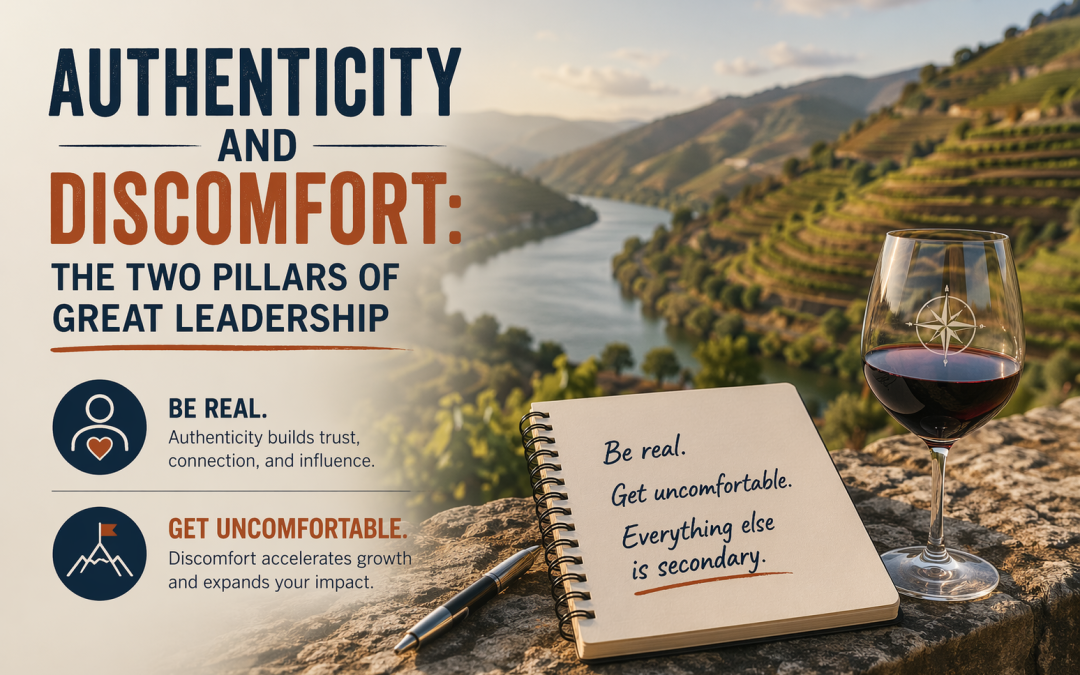
We were deep in the Douro Valley—ten hours of winding our way through some of the most beautiful terrain on earth with lots of eating, wine tasting, and laughing along the way. It was my third time on this Camino tour and Susan’s first. Two other groups had joined us, and by midday we were all talking like old friends.
The Douro Valley is Portugal’s breathtaking, UNESCO-designated wine region, located about an hour and a half east of Porto. Famous for its centuries-old, terraced vineyards carved into steep river canyons, it is the world’s oldest demarcated wine region and the birthplace of Port wine.
It is about as far away (in every aspect) from my regular life as I can get.
A couple from Rochester, NY, sat across from us. When he learned I was an executive coach, he paused, leaned in, and asked the question people always ask when they get access to someone who works with leaders nearly every day:
“What’s the most important thing for a leader?”
Before I could think, filter, or polish the answer, the words came right out of me: “Being authentic and getting uncomfortable.”
Even I was a little surprised—not because the answer was new (it is absolutely not!), but because it rose so quickly and clearly while I was miles away from my everyday just sitting in a beautiful other country, relaxed, unhurried, sipping wine. It was as top‑of‑mind as the vintage we were drinking. And I smiled as I watched him sit back and let my answer sink in.
Authenticity: the First Non‑Negotiable
People are drawn to leaders who are real. Not perfect. Not polished. Not performing. Just real. No one is attracted to a narcissist—the “full of themselves” leader who needs the room to orbit around them. And no one trusts the leader who collapses when things get tough. As I’ve always said: “Everyone is a good captain in a calm sea.”
Authenticity is what keeps people steady when the sea isn’t calm. Think of leaders like:
- Jesus—steady, present, grounded in truth
- Nelson Mandela—authentic even in suffering
- Abraham Lincoln—humble, honest, human
- Mother Teresa—authentic service, not performance
People follow authenticity because it creates trust, safety, and connection. It gives others permission to be human, too.
Getting Uncomfortable: The Accelerator
The second part of my answer surprised him even more. “The more uncomfortable you get,” I told him, “the more accelerated your leadership development becomes.”
Leadership is hard. It is constantly challenging. Everything changes all the time—the expectations, the pressure, the visibility, the stakes. And the leaders who grow the fastest are the ones who willingly step into discomfort. They more quickly become good at:
- difficult conversations
- new responsibilities
- unfamiliar environments
- honest feedback
- personal growth
- emotional exposure
Comfort never made anyone a better leader. Discomfort always does.
And the opposite is true, too. Avoid discomfort long enough, and your leadership abilities will plateau. Your influence shrinks. Your world gets smaller. Guaranteed.
Why These Two Ideas Immediately Rose to the Surface
Maybe it was the wine. Maybe it was the beauty of Portugal. Maybe it was the Camino working its magic on me. But I think my immediate and genuine response was something deeper.
I was finally calm. My mind wasn’t racing. My nervous system had stopped bracing for what’s next. And when you’re calm and collected, the truth rises.
Authenticity. Discomfort. Those are the two pillars I’ve seen shape every great leader I’ve ever coached. Not strategy. Not intelligence. Not charisma. Not even experience. Authenticity and discomfort.
One keeps you grounded. The other keeps you growing.
Final Thought
When my new and curious traveling companion asked me that question in the middle of a fabulous wine tour, I didn’t hesitate and I didn’t give him a textbook answer. I gave him the truth, and that truth came quickly from what I truly believe, from what I consistently coach the people I work with each day: Be real. Get uncomfortable. Everything else is secondary.
These aren’t just leadership principles. They’re life principles, too. They work at home and on the Camino. I think he got that.
Recent Comments