
A newly promoted company president I know complained that he was frustrated. He was working harder than ever, with longer hours, more pressure, and way more responsibility. And yet, he felt less effective than ever before in his career.
When I asked him to describe his day, his answer wasn’t surprising. Not at all.
He was spending his time reviewing proposals, editing presentations, solving operational problems, answering questions his team should be answering, and making decisions others could be making.
In many ways, he was doing exactly what had gotten him promoted in the first place. And that was the problem.
The Leadership Paradox
Most successful leaders spend years building a reputation for being dependable, responsive, and productive. They solve problems, hit deadlines, deliver results. Often, they do the work of two or three people. That’s why they get promoted. But eventually the job changes.
The higher you go, the less valuable your personal production is and the more valuable your leadership becomes. Yet many leaders never make that transition. They become the highest-paid individual contributor in the company.
The Shift
A sales manager can be the best salesperson. The company president simply cannot. An engineering manager can be the smartest engineer. The CEO doesn’t have time for that.
At some point, the scoreboard changes. The question is no longer: “How much can I accomplish?” The question becomes: “How much can this organization accomplish because of my leadership?”
That’s an entirely different way of working.
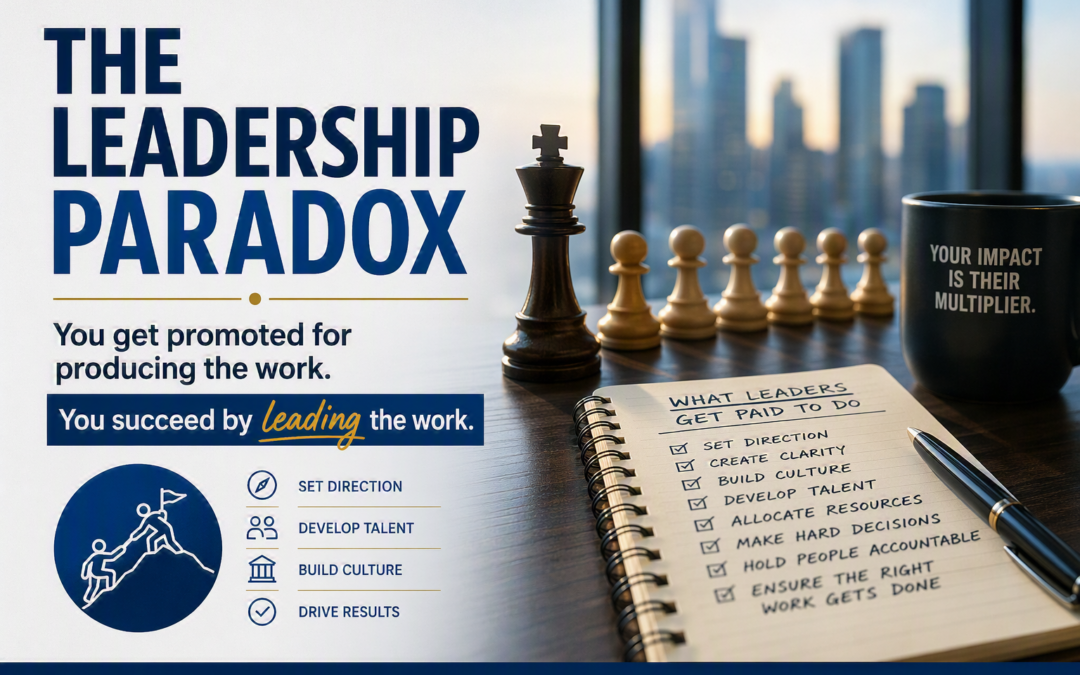
What Leaders Get Paid to Do
Leaders get paid to:
- Set direction
- Create clarity
- Build culture
- Develop talent
- Allocate resources
- Make hard decisions
- Hold people accountable
- Ensure the right work gets done
Guess what? None of those things provides the immediate satisfaction of checking another task off your list. In fact, these tasks can make most days feel less productive. But they are infinitely more valuable to the company.
The Hardest Part
The hardest part of leadership isn’t learning what to do. It’s learning what to stop doing. Many leaders struggle to let go of the very things that made them successful in the first place. Not because they can’t delegate. Because they can’t surrender competence.
For years, their identity was tied to being the person with the answers, the problem-solver, the fixer. The person everyone depended on.
Leadership requires letting some of that go. And yes, it feels slower and messier and riskier. But it is the only path to scale.
The Closing Truth
I’ve watched countless presidents and CEOs wrestle with this during their first few years in their elevated roles. Most believe the next level requires them to work harder when, usually, it requires them to work differently.
The organization didn’t promote them because it needed a bigger producer. It promoted them because it needed a leader. You get promoted for producing the work. Then you succeed (and get paid more) for leading the work.
And when that finally clicks, leadership starts to scale.
Recent Comments